

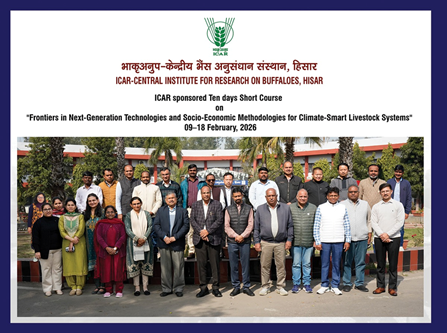
The ICAR-sponsored ten-day short course on “Frontiers in Next-Generation Technologies and Socio-Economic Methodologies for Climate-Smart Livestock Systems” was successfully organized at ICAR-Central Institute for Research on Buffaloes from 09 to 18 February 2026. The programme was inaugurated by Dr. Mukesh Jain, Director, Northern Region Farm Machinery and Tractor Training Institute, Hisar, Haryana who highlighted the growing urgency of addressing climate change impacts through technological innovation combined with sound socio-economic research methodologies. He emphasized that climate-resilient livestock systems will play a critical role in ensuring food security, nutritional sustainability, and farmers’ livelihoods in the coming decades. The short course covered a wide spectrum of themes such as Artificial Intelligence, Internet of Things (IoT), Machine Learning applications in livestock science, Geographic Information Systems (GIS), biosensors, reproductive biotechnologies, semen cryopreservation, ovum pick-up and in-vitro embryo production, climate-smart feeding modules, and precision livestock farming.
The programme was carefully designed to create a strong interface between cutting-edge technological advancements and robust socio-economic evaluation frameworks in livestock research. The short course had 16 participants from diverse academic and professional backgrounds, representing states including Bihar, Uttar Pradesh, Nagaland, Haryana, and Rajasthan Apart from internal experts of ICAR-CIRB, distinguished resource persons from premier institutions including CSIR-Central Scientific Instruments Organisation, ICAR-Indian Agricultural Statistics Research Institute, ICAR-Indian Agricultural Research Institute, Centre for Research on Innovation and Science Policy, Haryana Agricultural University and Lala Lajpat Rai University of Veterinary and Animal Sciences enriched the programme with their specialized expertise. Sessions on statistical tools, randomized controlled trials (RCTs), field experimental design, data pre-processing, model validation techniques, and impact evaluation strengthened participants’ understanding of scientific rigor in climate-smart livestock research.
The course placed significant emphasis on experiential learning. Participants underwent hands-on training sessions on thermal imaging for buffalo health monitoring, data visualization techniques, machine learning model applications, and reproductive technologies. Exposure visits were organized to CIRB’s animal farms, semen freezing laboratory, modern livestock sheds, as well as to NRFMTTI and NRC Equines. The valedictory function was graced by Dr. S. S. Dahiya Former Director, ICAR-CIRB which marked the successful culmination of the ten-day programme. In his address, he reflected on the comprehensive academic deliberations, practical field exposure, and interactive learning experiences undertaken during the course. Participants expressed deep appreciation for the interdisciplinary design of the programme, which effectively integrated advanced next-generation technologies with robust socio-economic methodologies essential for climate adaptation and sustainable livestock development. The short course was coordinated under the leadership of Dr. Sunesh Balhara, Senior Scientist (Agricultural Statistics) as Course Director, with Dr. Gururaj M, Scientist (Agricultural Economics) and Dr. Aiswarya S., Scientist (Agricultural Extension) serving as Course Coordinators.

